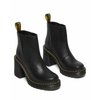
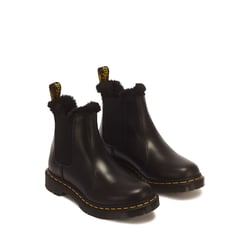
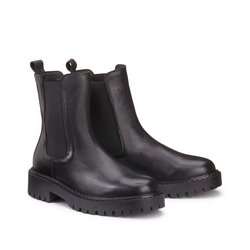
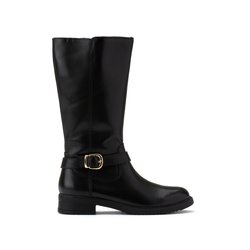
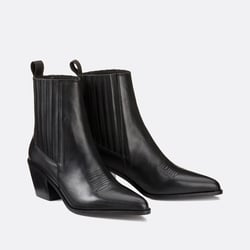
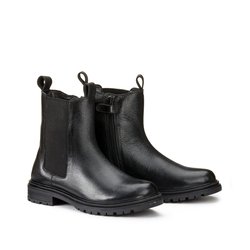
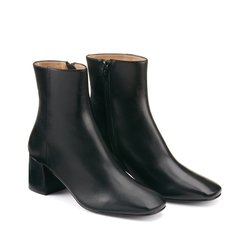
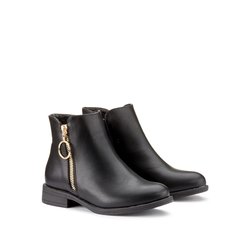
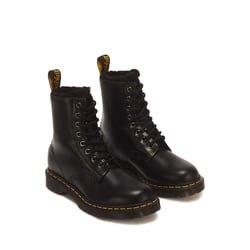
Glossy finish, practical ankle coverage
Black patent boots bring a glossy surface to everyday outfits without asking you to rethink your whole wardrobe. The shine gives dark jeans a clearer outline, while ankle-height coverage sits neatly beneath straight trousers or alongside cropped hems. For busy mornings, that combination makes an ankle boot particularly useful: you get more coverage than a shoe, without the extra length of a knee boot.
When choosing your pair, concentrate on three things: how much shine you want, how the opening sits around your ankle, and how comfortable the sole and heel feel during your usual day. At La Redoute, we recommend comparing these details with the clothes you wear most often, whether that means tailored trousers for work or denim for weekend errands.
Compare the finish before choosing your pair
Patent leather and leather-look materials
A patent finish has a smooth, reflective surface, but that appearance does not tell you everything about the material underneath. Some boots use coated leather; others have a synthetic, black patent leather-look finish. Check the upper, lining and sole information separately, because each affects how the boot feels, flexes and needs to be cleaned. A leather upper does not automatically mean a leather lining, for example.
Product photographs can help you judge the strength of the gloss. Look at images taken from several angles: a broad reflection across the toe suggests a noticeably shiny surface, while smaller highlights may indicate a gentler sheen. If you want footwear that stands out against a wool coat, a stronger gloss creates a visible contrast with the coat's textured fabric.
Match the shine to your everyday clothes
Black patent boots brighten dark jeans during weekend city errands by catching the light around the hem. Keep the rest of the outfit straightforward: straight-leg denim, a knitted jumper and a short jacket give the finish room to register. If you prefer less reflection, compare patent with flat suede boots; the softer-looking surface changes the outfit without requiring a different trouser shape.
For evening plans, patent can also provide a polished alternative to metallic footwear. If you usually consider gold low heel shoes with black trousers, glossy black ankle boots offer more coverage while keeping a defined finish below the hem. The effect is quieter in colour, but still noticeable under indoor lighting.
Get the ankle fit and opening right
The shaft height and opening deserve as much attention as the toe shape. An ankle boot should allow you to walk, climb stairs and sit without its top edge pressing into your leg. Try boots with the socks you intend to wear, especially if your commuting socks are thicker than those you use for an evening out. That small change can affect pressure across the instep and around the ankle.
A close opening works neatly beneath straight trousers, while a wider shaft can leave more room for thicker socks or tucked-in slim jeans. However, a wide opening is not the same as a wide fit: the first describes space around the lower leg, while the second generally concerns room around the foot. Check any available measurements rather than relying on photographs alone.
- Stand with your weight evenly distributed and check that your toes are not pressed against the front.
- Walk across the room to assess whether the heel lifts excessively or the upper pinches.
- Bend your knees slightly to test whether the shaft digs into the front of your ankle.
- Check that a zip closes without force and that elastic panels are not stretched tight while standing.
- Try both boots, as one foot may need slightly more space than the other.
If you are moving from flexible footwear found through women's sock shoes searches, pay particular attention to how a patent upper bends. A structured boot can feel noticeably firmer over the toes and instep. Do not assume persistent pressure will disappear with wear, especially with a coated or synthetic upper.
Balance heel height with everyday comfort
Flat soles and low block heels
For days involving station steps, supermarket aisles and long pavements, start by comparing a flat sole with a low block heel. A broader heel gives you a larger contact area than a narrow one, although comfort still depends on the boot's overall construction. Assess the sole, cushioning and heel together, rather than treating heel height as the only measure of comfort.
Look for cushioning under the heel and forefoot, enough flexibility for a natural step, and a sole profile suited to your routes. A very thin sole may let you feel uneven paving more sharply. A heavier sole can provide separation from the ground, but check that its weight does not make walking tiring. Try a few brisk steps indoors before deciding.
Chelsea openings and zipped styles
A Chelsea shape uses elasticated side panels for pull-on access, making it practical when you are leaving home with your hands full. If you are comparing block heel Chelsea boots, check how easily your foot passes through the opening and whether the back of the boot stays secure once on. A pull tab can help, but you should not need to tug hard every time.
A zipped style offers a different kind of access and may suit a closer ankle shape. Make sure the zip does not rub against your ankle bone and that any internal covering lies flat. Women who wear an ankle support or an insole should test the boots with it in place, since added volume can change the fit substantially.
Wear black patent ankle boots through a busy week
Wool coats and rainy commutes
Pair black patent boots with a wool coat for rainy commutes, keeping trouser hems clear of wet pavements. Cropped straight trousers work particularly well because the fabric is less likely to drag through puddles. Choose socks that remain covered by the shaft if you want an uninterrupted line between your trousers and boots.
A glossy finish is not a waterproof guarantee. Check the product description for any stated water resistance, and remember that water can enter around seams, elastic panels or zips. For a route with slippery station floors, inspect the outsole pattern too. If heavy rain is forecast, footwear specifically designed for wet conditions may be the more practical choice.
Weekend errands and concert outfits
For weekend city errands, wear your black pair with dark jeans and a roomy jumper, then add a cross-body bag to keep your hands free. Let a straight jean hem sit just above the shaft or fall over it without bunching. Too much gathered fabric can press against the opening and make the ankle area feel bulky.
Wear black patent boots to keep concert outfits polished after rain, provided the conditions suit the footwear's stated protection. A low heel, secure fit and comfortable toe box matter when you will be standing for several hours. With a skirt and opaque tights, black patent gives a continuous dark line; compared with gold ankle boots, it draws less attention to colour and more to the reflected light.
Care for the glossy surface without dulling it
Patent needs care suited to its coating, not simply the routine you use for ordinary leather. Start with a soft, slightly damp cloth to remove everyday dust and light marks, then dry gently with another soft cloth. Follow the manufacturer's instructions before applying any product, and test an approved cleaner on a discreet area first.
Avoid abrasive brushes, vigorous rubbing and unapproved solvents, which may mark or dull the glossy surface. Conventional shoe polish is not automatically suitable for patent. If a scuff remains after gentle cleaning, use only a treatment recommended for that specific material rather than trying household cleaning products.
- Wipe away splashes after wear rather than leaving dirt to dry on the surface.
- Let damp boots dry naturally, away from radiators and other direct heat sources.
- Store them without pressure against the toes or shafts to reduce unwanted creasing.
- Keep pale items and other coated materials from resting against the finish, as colour transfer can be difficult to remove.
- Check heel tips and soles regularly, particularly if your commute includes rough paving.
Compare the details that affect everyday value
When browsing women's boots, use a size, fit or heel-height filter where available to narrow the options around your actual routine. Then compare each item on material, fastening, sole construction and care requirements. A lower price is less useful if the toe shape pinches or the shaft catches every time you climb stairs.
Make your final comparison in a complete outfit. Try the boots with your usual trousers, coat and socks, then walk and sit in them indoors. Check the return conditions before removing labels or wearing them outside. The pair worth keeping is the one whose shine suits your clothes, whose ankle opening allows easy movement, and whose comfort holds up beyond the first few steps.