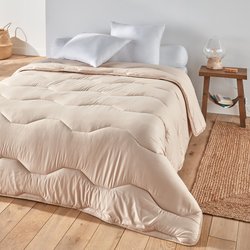
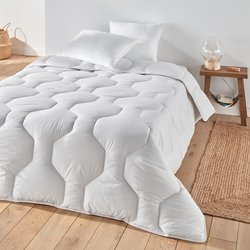
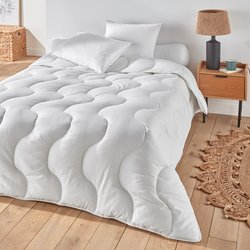
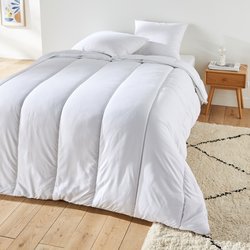
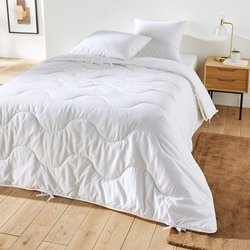
Natural filling for lighter nights
When warm evenings leave you pushing heavy bedding aside, a lightweight summer duvet can help you settle without losing the comfort of a covering. Natural filling is worth considering if you enjoy a softly draping duvet: duck or goose down, often combined with feather, can provide loft without a bulky feel. For summer, though, the key is choosing a low warmth rating rather than assuming that every natural-filled duvet will feel cool.
A king-size duvet gives you room to turn over and share the covers, but its filling, tog rating and dimensions all need to suit your bed. We recommend checking these three details together. That way, you can choose bedding that fits your existing cover and feels comfortable when your bedroom stays warm after sunset.
Start with warmth: choosing a summer tog
The tog rating describes how much thermal insulation a duvet provides. A lower tog means less insulation, which is generally more suitable for summer. It does not describe the duvet’s weight, its quality or how soft it feels, so two duvets with the same rating can feel different when you pull them over your sheets.
A 4.5 tog duvet is a common summer choice, particularly if your room cools down overnight. If your bedroom holds heat, or you regularly wake feeling hot, a lighter option around 1 to 3 tog may be more comfortable. These are starting points rather than fixed rules: your nightwear, mattress, room temperature and whether you share the bed all affect how warm you feel.
- For a warm bedroom, consider a low-tog duvet and a lightweight cotton cover rather than a thick, brushed bedding set.
- For breezy evenings, use a summer king duvet over a sheet, keeping a light blanket nearby if the temperature drops.
- If you and your partner prefer different temperatures, add a small blanket on one side instead of increasing the warmth across the whole bed.
- When night-time temperatures rise, start with the sheet alone and fold your summer duvet towards the foot of the bed until you need it.
At La Redoute, our catalogue includes the white SILENTNIGHT Super Snuggly 15 Tog Duvet, designed for super snuggly, cosy comfort all night long. Its 15 tog rating makes it a useful contrast when shopping for summer: it provides substantially more insulation than a lightweight summer duvet and is better considered for cold conditions or winter use.
Natural filling: understanding down and feather
What duck and goose fillings feel like
Down consists of soft clusters that trap air, while feathers have a central quill and give the filling more structure. A down-rich duvet can feel light and lofty; a feather-rich blend often feels more substantial. Both duck and goose fillings appear in natural-filled duvets, but the bird type alone does not tell you how suitable a product is for a warm bedroom.
Check the tog rating and filling percentages together. A high-tog goose down duvet is still insulating, even if it feels light when you lift it. For summer nights, look first for the warmth level you need, then compare the down-to-feather blend, casing and care instructions. This helps you avoid choosing a wonderfully soft duvet that leaves you too warm at three in the morning.
If you are also updating a smaller bed, you may come across a duck down duvet double while browsing. The same checks apply, but make sure you return to the king size option before ordering for your main bedroom. A double duvet provides less coverage across a king mattress, which can become noticeable when two people turn away from each other.
Choose the casing and care routine to suit you
A cotton casing is worth looking for if you prefer a familiar, breathable fabric around the filling. Pairing it with a lightweight cotton duvet cover avoids adding the bulk of heavier bedding. The casing’s construction also matters: check whether the product description mentions compartments that help keep the filling distributed, especially if you dislike having to shake filling back into empty corners.
Natural filling needs care suited to the individual product. Before buying, check whether the duvet can be machine washed, whether your machine has enough capacity and how it must be dried. Down and feather filling must be dried thoroughly after washing, following the care label, rather than put back on the bed while any dampness remains.
If you have an allergy, do not assume that either natural or synthetic filling will automatically suit you. Read any specific allergy-related product information and consider your own known triggers. A washable duvet and regular washing of covers may fit your routine better, but the permitted wash temperature and drying requirements should guide your choice.
Get the king-size fit right before choosing your cover
In the UK, a standard king-size duvet usually measures 230 x 220 cm. It is designed for a standard king mattress measuring 150 x 200 cm. The extra width allows the duvet to fall over the sides, although the visible drop will vary with mattress depth, bed-frame height and how you arrange the bedding.
Take a quick measurement before ordering, particularly if you are replacing a duvet but keeping your favourite cover. Check the label inside the cover or lay it flat and measure from seam to seam. Your duvet and cover should have matching stated dimensions: a cover that is too large can leave loose fabric at the edges, while one that is too small can compress the filling and cause bunching.
It also helps to view the bed as a whole. On a deep king mattress, a standard king duvet may not hang as far down the sides as you expect. If generous coverage is your priority, compare the measurements of a larger duvet, remembering that you will also need a matching larger cover. Do not assume that a king bedding set contains the right cover simply because its fitted sheet suits your mattress.
Make your summer bedding easy to adjust
For warm summer nights, keep the layers simple: a fitted sheet, an optional flat sheet and your low-tog king duvet. This lets you uncover your feet or fold the duvet back without stripping the entire bed. If you wake chilly just before morning, the duvet is still within reach rather than stored away in a cupboard.
Your pillows and pillowcases deserve a check too. Heavy pillow protectors and thick fabric can change how warm the bed feels around your head, even after you have swapped your winter duvet. Choose pillowcases that suit your comfort preferences and check the washing instructions across the whole bedding set so laundry day stays manageable.
A coverless duvet is another option if you prefer not to change a separate cover. Before choosing one, check the finished dimensions, tog rating and whether you can wash and dry the entire item at home. For a large king duvet, machine capacity matters: a convenient design still needs enough space for washing according to its label.
When your new summer duvet arrives, follow any unpacking and airing instructions before use. Fit the corners neatly into the cover and give the duvet a gentle shake so it lies evenly. On the first few nights, adjust the sheet or nightwear before deciding whether the warmth rating suits you; changing several layers at once makes it harder to identify what helps you sleep comfortably.
Size and cover details to check before you buy
What is the difference between a king size duvet cover and a queen size duvet cover?
The difference depends on the country and brand, because queen is not a consistently standardised duvet-cover size in the UK. A UK king-size duvet cover usually measures 230 x 220 cm. A cover described as queen may follow another country’s sizing system, so the name alone cannot confirm whether it will fit your duvet. For example, some US queen covers measure around 229 x 229 cm, but measurements vary between retailers.
Match the dimensions in centimetres, not just the size name. This is especially useful when shopping across international brands or replacing one piece of an existing bedding set. A cover that looks close in width may still be longer than your duvet, leaving an unfilled section at the bottom.
- Read the stated width and length on both the duvet and cover.
- Check the retailer’s size guide rather than relying on a queen or king label.
- Confirm which pieces a set includes, as sheet and pillowcase sizing may also differ.
For a practical example, if your summer duvet measures 230 x 220 cm, choose a cover with those same stated measurements. Avoid buying a queen cover simply because its packaging suggests it suits a similarly sized bed: mattress compatibility and duvet compatibility are separate checks.
What is the size of a king size duvet in the UK?
A standard UK king-size duvet usually measures 230 cm wide by 220 cm long. It is commonly used on a king bed with a mattress measuring 150 x 200 cm. These are different measurements because the duvet needs extra fabric and filling to cover you and extend beyond the mattress edges. Always confirm the individual product dimensions before buying, particularly when browsing imported bedding.
As a simple guide to nearby UK sizes:
- A double duvet usually measures 200 x 200 cm.
- A king duvet usually measures 230 x 220 cm.
- A super king duvet usually measures 260 x 220 cm.
The main pitfall is confusing your mattress size with the duvet size. A cover measuring 150 x 200 cm would not be the appropriate cover for a standard UK king duvet, even though those measurements describe a king mattress.
For example, if you share a 150 x 200 cm bed and already own a 230 x 220 cm cover, a summer king duvet with matching dimensions is the straightforward replacement. If your mattress is particularly deep or you often run short of coverage, measure the drop you would like on each side before considering a larger duvet and cover together. This keeps your choice focused on how you use the bed, rather than the size label alone.