Choose the size that suits your routine
A bath towel takes up less space on the rail and in the washing machine; a bath sheet gives you more fabric to wrap around your body. That difference matters when you are drying off before work, sharing a compact bathroom or choosing towels for several people. Before you pick a shade of blue, start with the dimensions that fit both you and your storage.
We recommend comparing three things when shopping for blue bath towels: size, absorbency and care requirements. A generous towel may feel comfortable around your shoulders, but it also needs enough hanging space to dry between uses. A smaller option may suit a busy household better if you wash towels regularly and have limited drying room. Here is how to make those choices with your daily routine in mind.
Bath towel sizing: start with the measurements
Product names are useful starting points, but measurements give you a clearer comparison. UK towel sizes vary between brands and ranges, so always read the dimensions on the individual product page. Two products described as bath towels can offer noticeably different coverage.
Compare the main towel sizes
- Face cloth: often around 30 × 30 cm. A small square for washing your face or keeping beside the basin; it is not intended for drying your whole body.
- Hand towel: commonly around 50 × 90 cm or 50 × 100 cm. This size sits neatly beside the sink and gives you enough fabric for drying your hands.
- Bath towel: commonly around 70 × 125 cm or 70 × 140 cm. A practical everyday choice for drying after a shower without filling a small towel rail.
- Bath sheet: often around 90 × 150 cm to 100 × 180 cm. The extra width and length provide more coverage for wrapping around your body.
These are typical examples rather than fixed standards. If you are replacing a towel you already like, measure it flat and compare those dimensions with your new choice. This is more reliable than assuming that every product labelled “large” will be the same size.
Match the size to your body and your space
For wrapping, width and length do different jobs. When you hold a towel horizontally around your body, its longer measurement usually determines how far it reaches around you, while the shorter measurement affects coverage from top to bottom. Check both, particularly if you want fabric to overlap securely rather than simply meet.
Next, measure your towel rail. A large sheet folded into several layers may stay damp at the centre, especially in a bathroom with limited airflow. Choose a size you can hang with as little overlap as possible. If your rail is narrow, an everyday bath towel may be easier to manage than a larger sheet, even when you prefer generous coverage.
Absorbency: look beyond size and thickness
A bigger towel provides more fabric for drying, but size alone does not tell you how quickly it will take moisture off your skin. Fibre composition, the structure of the towelling and its condition after washing also matter. Cotton is a familiar choice for bath towels because it absorbs moisture and can feel soft against the skin.
Use gsm as a guide to weight
The abbreviation gsm means grams per square metre: it describes the weight of the fabric over a given area. As a broad guide, towels around 400-500 gsm tend to feel lighter, while options around 500-650 gsm generally feel fuller. Higher weights can give a dense, cushioned feel, although the weave and yarn also affect how a towel handles.
Gsm is not an absorbency score. A heavier towel is not automatically the best choice for every bathroom, and two towels with the same gsm can feel different. For frequent showers in a shared home, a medium-weight option may be easier to wash and dry. If you prefer a substantial hotel-style feel and have plenty of drying space, a denser towel may suit you better.
Balance a soft feel with drying time
Descriptions such as “super soft” or “luxury” can help you understand the intended feel, but check the composition, dimensions and care instructions alongside them. A thick bath sheet may feel comfortable after a long soak, yet take longer to dry than a smaller towel of similar construction.
If you shower every morning, think about whether your towel will be dry before its next use. You may find that two medium-weight towels, used in rotation, work better than one very thick option left folded over a hook.
Choose blue shades that work with your bathroom
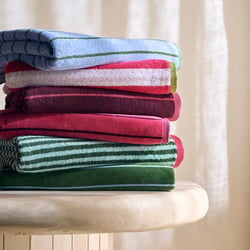
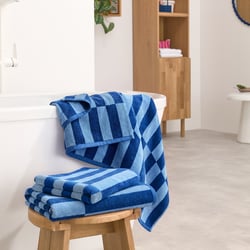
Once you have settled on size and weight, use colour to organise your bathroom as well as decorate it. Pale blue stands out against dark tiles, while navy creates a clear contrast with a white bath or basin. If several people share the room, different blue shades can help everyone identify their own towel without adding labels.
For a coordinated set, choose bath towels, hand towels and face cloths from the same range where available. Check each item's dimensions separately: matching colours do not necessarily mean that every piece comes in several sizes.
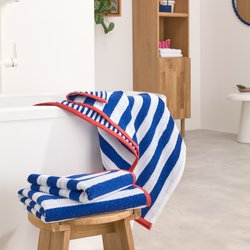
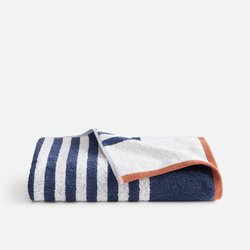
If you want a design that is easy to distinguish on a shared rail, compare plain options with striped towels. For a bathroom with plain walls and flooring, patterned towels can introduce a visible design without changing fittings or paint. You could also assign yellow bath towels to guests and blue ones to everyday household use, making clean towels easier to sort in the linen cupboard.
Check texture as well as colour
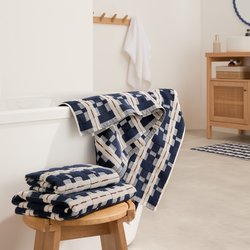
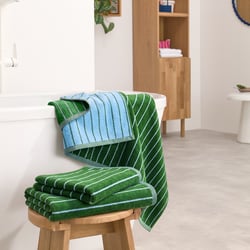
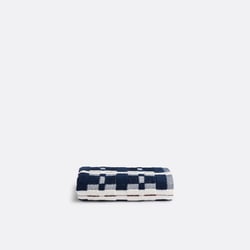
At La Redoute, our Meiri Maxi Bath Towel in Jacquard Towelling by LA REDOUTE INTERIEURS has a jacquard check pattern, with alternating fleece and smooth weave on each side, giving it a contemporary graphic style. If you prefer a visible pattern within the fabric, this is a detail to compare with plain towelling when browsing our selection. Check the listed dimensions before deciding whether a maxi format suits your rail and washing routine.
Put your towel choice to work every day
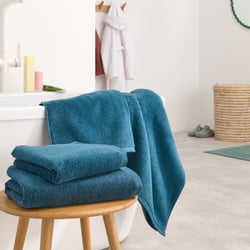
Wrap up in soft blue bath towels after morning showers when you want enough coverage to dry comfortably before getting dressed. If you usually dry off straight away rather than keeping the towel wrapped around you, a standard bath towel may provide all the fabric you need while taking up less space in the wash.
Keep blue bath towels beside the tub for quick drying, but place clean ones on a shelf or rail away from splashes. For a long bath, a larger sheet can cover your shoulders and body while you step out and dry off. Make sure you can reach it without stretching across a wet floor.
You can also reach for blue bath towels after swimming in the garden pool. For repeated dips, consider a manageable size that you can spread out between uses rather than leaving it bundled on a chair. Check the care label and wash after exposure to pool water; choosing navy does not remove the need to rinse away pool chemicals.
Care for blue bath towels without adding unnecessary work
Before using a new towel, follow its care label and wash it as directed. This can help remove loose fibres and finishing residues. Separate dark blue and navy towels from white items, particularly during early washes, and use a detergent suitable for the fabric and colour.
- Avoid overloading the washing machine. Towels need room to move during washing and rinsing; several large bath sheets can fill a drum quickly.
- Measure detergent according to the product instructions, load size and water hardness. Excess detergent can leave residue in the fabric.
- Limit fabric conditioner, as it can coat fibres and reduce absorbency. Check the towel manufacturer's advice before using it.
- Shake towels out before hanging them, then spread them over the rail rather than leaving them in a heap.
- Follow the care label for tumble drying and temperature settings. Do not assume that every cotton towel accepts the same heat.
Store towels only when completely dry. A thick folded sheet can hold moisture inside even when the outer surface feels dry. Before putting it in the linen cupboard, check the folds and hems. When choosing a larger size, allow for that extra drying time as part of your normal laundry routine.
What to know before choosing your towel size
What are the key differences between a bath sheet and a bath towel in the UK?
The main difference is size: a bath sheet is generally larger than a bath towel, offering more coverage for wrapping around your body. In the UK, a bath towel commonly measures around 70 × 125 cm or 70 × 140 cm, while a bath sheet often measures around 90 × 150 cm to 100 × 180 cm. These measurements vary, so compare the dimensions rather than relying on the product name alone.
- Choose a bath towel if you want an everyday drying option that fits a smaller rail and takes up less space in a wash load.
- Choose a bath sheet if you want more fabric around your waist, chest or shoulders after bathing.
- Compare composition and gsm separately: a larger size does not automatically mean thicker fabric or better absorbency.
The practical difference continues after you have dried yourself. A sheet made from the same fabric as a smaller towel contains more material, so it is bulkier to wash, hang and store. Avoid buying the largest option without checking where it will dry; folded layers on a narrow rail can remain damp.
For example, if you shower before work and share one rail with another person, two standard bath towels may be easier to spread out. If you have a wide rail and prefer to stay wrapped while applying body lotion or drying your hair, a bath sheet may suit your routine better. The best choice is the size that gives you enough coverage and can dry properly before you use it again.