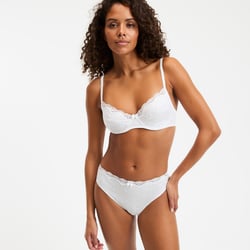
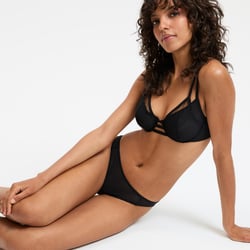
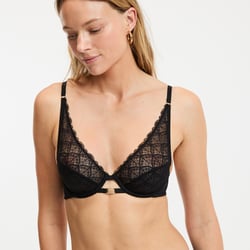
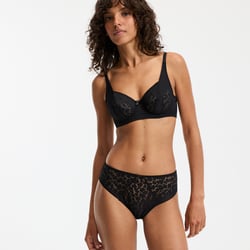
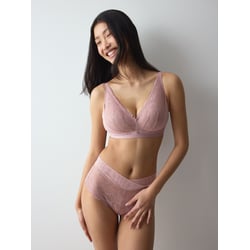
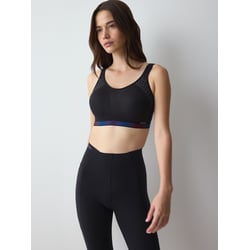
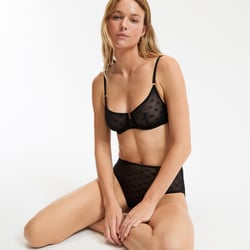
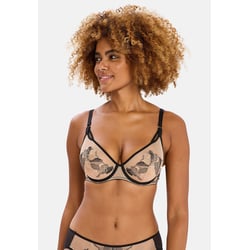
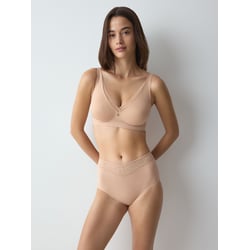
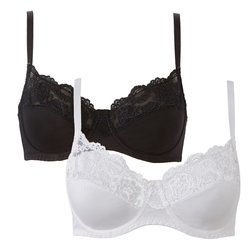
Understand your 32E fit
A 32E bra should give you support around your ribcage and enough room in each cup for your breast tissue, without digging in or leaving noticeable gaps. If you adjust your straps before heading to work, the aim is a small finishing adjustment, not a daily attempt to compensate for a loose band. Understanding what the number and letter mean helps you spot the difference.
Whether you choose a full cup style under a weekday blouse or a plunge bra beneath a lower neckline, start with the fit rather than the label alone. At La Redoute, we recommend checking the size guide for the bra you are considering, then assessing the band, cups and straps together when you try it on.
How 32E bra sizing works
The number describes the band size
The 32 in 32E refers to a UK band size. This is the part of the bra that fastens around your ribcage and provides much of its support. It is not a guarantee that every size 32 band will have the same unstretched measurement: fabrics, elastic and construction affect how a bra feels when worn.
For a starting measurement, place a soft tape measure around your ribcage directly beneath your breasts. Keep it level and comfortably snug, without pulling it tight enough to compress your skin. Follow the relevant brand’s sizing instructions, as different guides may calculate the recommended band differently.
A supportive band should sit level around your body, rather than rising towards your shoulder blades. Try raising your arms and reaching forward as you would when taking a folder from a shelf. If the band shifts noticeably, check whether it is too loose before tightening the straps.
The letter describes cup volume relative to the band
The E describes the cup size in relation to that 32 band. It is not a fixed volume across all band sizes. A 34E has more cup volume than a 32E, while a 30E has less. This is why changing only the band number can also change how much room you have in the cups.
In the usual UK sequence, cup sizes progress through D, DD, E and F. Other sizing systems use different letter sequences, so check whether a product is listed in UK, European or another sizing system before ordering. A letter that looks familiar may represent a different fit.
Measuring around the fullest part of your bust can help you find a starting size. Keep the tape horizontal and avoid flattening your breasts. A lightly structured, non-padded bra may help you take this measurement, provided it fits reasonably well and does not compress your bust.
Check your fit before choosing a style
Put your bra on with the straps loosened slightly, then lean forward and gently settle your breast tissue inside the cups. Fasten a new bra on its loosest comfortable hook setting where possible, leaving room to tighten the band as the elastic relaxes through wear. Adjust the straps last.
- Check the band: it should feel secure without painful pressure or restricted breathing.
- Check the cups: your breasts should sit inside them without spilling over the neckline or escaping underneath.
- Check the wires: on an underwired bra, they should follow the breast root rather than rest on breast tissue.
- Check the centre: on many wired designs, the centre panel should rest comfortably against your breastbone, although breast shape and construction can affect this.
- Check the straps: they should stay in place without making deep grooves in your shoulders.
- Check movement: sit down, lift your arms and bend forward to see whether the bra remains comfortable.
If one breast is larger than the other, fit the larger side first. A small strap adjustment or a removable insert on the smaller side may help balance the fit. Avoid choosing a cup that compresses the larger breast simply to remove a small gap on the other side.
Choose coverage for your clothes and your day
Full cup coverage for a fitted weekday blouse
A full cup bra covers more of the breast than a lower-cut design. If you choose a supportive 32E bra under a fitted weekday blouse, check both the neckline and the side profile. The cups should contain your bust without a ridge showing across the top, and the blouse should fasten without pulling between its buttons.
For example, Kate might try on her usual work shirt over a full cup bra, then sit at a desk and reach forward. This simple check reveals whether the neckline cuts in during movement or the band becomes uncomfortable when seated. Test your bra under the clothes you actually wear, rather than judging it only while standing still.
A seamfree bra can help reduce visible cup seams beneath a close-fitting top. A padded style offers more nipple coverage, while an unpadded option may feel less bulky. Padding does not automatically mean extra volume: some moulded cups use a thin layer mainly to hold their shape.
Balcony, balconette and plunge shapes
A balcony or balconette bra usually has a more open upper cup and wider-set straps than a full cup design, although the names and cuts vary between brands. These shapes can work beneath square or wider necklines. Check that the straps stay on your shoulders and that the cup edge does not cut across your bust when you move.
A plunge bra has a lower centre, making it useful under a V-neck dress or wrap top. If your breasts move towards the centre during wear, check cup depth and containment rather than assuming you need tighter straps. A different plunge construction may suit your shape better.
A satin bra can provide a smooth surface beneath some fabrics, while lace may create a visible texture under a thin shirt. Black bras are useful beneath darker clothing, but can show through a pale blouse. Check the result in daylight before leaving home.
Account for shape, height and changing needs
Two people wearing 32E can need different cup shapes. One may need more depth near the centre, while another needs wider wires or a stretch upper panel. A curvy outline alone does not tell you which construction will fit: look at where your current bra gaps, presses or shifts.
If you are a tall woman, check the available strap length rather than assuming a larger band will solve straps that feel short. Increasing the band unnecessarily can reduce stability around your ribcage. Equally, if straps remain loose at their shortest setting, a different strap arrangement may be more useful than a smaller cup.
For days when you prefer a wire-free option, assess the firmness of the underband, the separation between the cups and how securely the fabric holds your bust during normal movement. A non-wired bra can offer support, but its construction and intended use matter more than the absence of wires alone.
If you are choosing a lace nursing bra, allow for changes in breast fullness and check that the feeding clips are easy to use. Avoid pressure on breast tissue, and reassess your size as your needs change. When browsing sheer lingerie, check lining and seam placement if you plan to wear it beneath lightweight clothing.
Size details to check before buying
What is the bust size for a 32E bra size?
In a commonly used UK sizing calculation, a 32E corresponds to a full-bust measurement of approximately 38 inches, or 96.5 cm. This comes from a six-inch difference between the nominal band size and the bust measurement. However, that figure is a starting reference, not a guarantee that everyone wearing 32E measures exactly 38 inches around the bust.
Band-sizing methods vary, and your breast shape, fullness and the bra’s construction can all affect the size you need. Your actual underbust measurement should therefore be assessed using the brand’s own guide rather than inferred from the number 32 alone.
- Measure around your fullest bust point without squeezing the tape.
- Keep the tape level across your back.
- Compare both bust and underbust measurements with the product’s size chart.
- Use the resulting size as a starting point for a practical fit check.
For example, if your fullest-bust measurement is close to 38 inches and the guide recommends 32E, try that size and assess the cups while sitting and reaching. Do not dismiss spilling because your measurement matches the chart, or accept a loose band because the cup letter seems right. Avoid measuring over a heavily padded bra, which can add to the measurement and lead you towards an unsuitable size.
Is 34DD similar to 32E?
Yes. In standard UK sizing, 34DD is a sister size of 32E: it offers approximately the same cup volume with a larger band. Moving in the other direction, 30F is the usual sister size with a smaller band. These sizes are related, but they will not feel identical because the band tension, cup placement and strap positions can differ.
- 32E: the starting band and cup combination.
- 34DD: a larger band with approximately equivalent cup volume.
- 30F: a smaller band with approximately equivalent cup volume.
If your 32E cups fit comfortably but the band feels too tight, trying 34DD may help. First, check that the tightness is genuinely coming from the band: cups that are too small or too shallow can also make the whole bra feel restrictive. If your 32E band rides up, moving to 34DD is unlikely to solve the problem.
For a practical comparison, try both sizes in the same bra design. Raise your arms, sit down and check whether the cups remain secure without the band shifting. Avoid switching to 34E when you want the same cup volume and a looser band, because that changes both. Sister sizing is most useful as a nearby fit adjustment, not as a reason to accept an unstable band.
Keep your 32E bra comfortable between wears
After a warm afternoon walk, hand-wash your 32E bra if its care label recommends it. Use cool or lukewarm water and a suitable mild detergent, rinse gently, then press out excess water without twisting the cups or wires. Reshape padded cups and let the bra dry naturally, away from direct heat.
As you wear it over time, revisit the same fit checks: a level band, comfortable cups and straps that stay put. If you begin relying on very tight straps or the tightest hooks no longer hold the band securely, reassess the fit and condition. Your 32E label is a useful starting point; how the bra feels through your working day is the practical test.