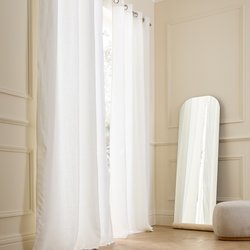
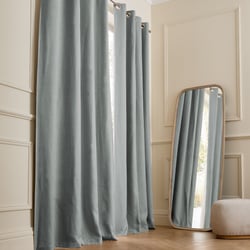
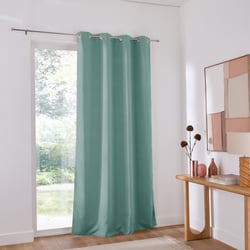
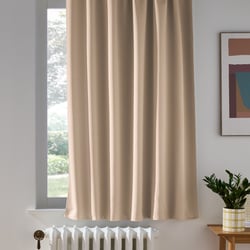
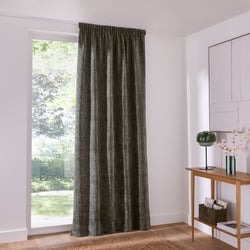
Choose your shade by the daylight in your room
The green you like on a screen can look quite different beside your window. Soft sage may appear grey in a north-facing bedroom, while olive can look warmer in a living room filled with afternoon sunshine. Start with the light your room receives, then consider fabric, opacity and measurements. This order helps you choose curtains that suit both the colour scheme and the way you use the space, whether you need privacy beside a street-facing window or less glare across the sofa.
Before you shop, look at your window in the morning, at midday and with the lamps switched on. Notice whether the light feels cool or warm, where direct sunshine falls and which furnishings sit closest to the glass. We recommend comparing green fabric samples beside your wall colour rather than against a white screen, because the surrounding colours affect how the shade appears.
Match your green shade to the direction of the light
Cool daylight: consider warmer greens
North-facing rooms often receive cooler, less direct daylight. In this setting, a blue-toned green can look cooler still, especially against pale grey walls. An olive or gently yellow-toned green can help the window sit more comfortably alongside oak furniture, cream upholstery and warm white paint. Choose a lighter version if the room already feels dim, particularly when the curtains cover part of the glass while open.
Check the shade at the window and beside your main furniture. A green that works against the wall may look different next to a large blue sofa or a reddish wooden floor. Hold a sample vertically, as the finished curtain will hang, and look at both the folds and the flatter areas. Shadows within the folds can make the fabric appear noticeably darker.
Strong sunshine: balance colour with glare control
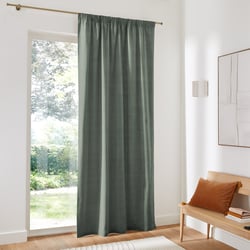
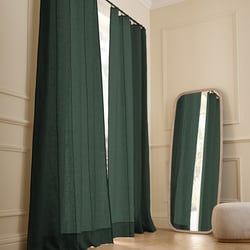
South-facing windows can support deeper greens because they receive stronger daylight for much of the day. Forest green can frame a bright window without appearing as heavy as it might in a shaded room. If your walls are already dark, a softer sage gives more contrast around the glass and makes the curtain edge easier to distinguish.
West-facing living rooms need particular attention in the afternoon. Green curtains soften afternoon sunlight in the living room when you choose a light-filtering fabric and draw it across the brightest part of the window. A muted green can work well beside a beige sofa, while a denser fabric may be more useful if low sunshine shines directly onto your television.
Changing light: test morning and evening conditions
East-facing rooms are often bright early and more subdued later. A mid-tone green is worth considering for a dining area used for breakfast and evening meals, as very pale shades may look washed out in direct morning light. Test the colour under your usual bulbs too: warm lighting can bring out yellow notes in olive, while cooler bulbs may make sage appear greyer.
Choose fabric for the room, not just the colour
Cotton for an everyday, relaxed look
Cotton curtains work well in living rooms, bedrooms and dining spaces where you want visible fabric texture without a pronounced sheen. The weave and weight matter as much as the fibre: a lighter cotton can admit more daylight, while a denser cotton canvas generally gives the curtain more body. Always check the product description rather than assuming every cotton curtain offers the same privacy.
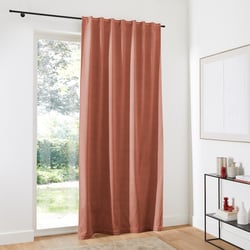
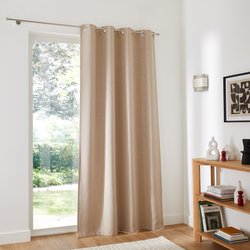
At La Redoute, our Scenario Cotton Curtain with Tab Top by LA REDOUTE INTERIEURS is made from cotton canvas. The tab top creates spaced folds along a pole, so it is useful to check how those tabs affect the finished hanging length. If you open and close your curtains several times a day, also consider whether this heading suits the way you want to move them.
Velvet for depth and a fuller drape
Green velvet can suit a bedroom with an upholstered headboard or a living room with substantial seating. Its surface catches light differently as you move around the room, so the same panel can appear lighter on a raised fold and darker in a recess. Leave enough wall space beside the window for the fabric to gather when open; a bulky stack can cover useful glass in a narrow room.
Velvet alone does not guarantee blackout performance. Check the opacity and lining separately from the fabric name. If you need darkness for daytime sleep, look for a stated blackout construction rather than relying on a deep green colour or a heavy-looking photograph.
Set the opacity around privacy, sleep and daylight
Light-filtering fabric for daytime use
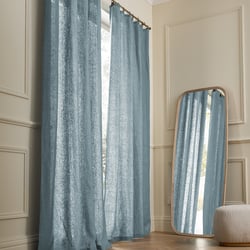
Light-filtering curtains reduce the intensity of incoming daylight without making the room as dark as blackout curtains. They are useful in a sitting room where you read beside the window or in a bedroom where you dress during the day. Green curtains add privacy while letting filtered daylight brighten bedrooms, provided the fabric offers enough coverage for the distance and viewing angle outside.
Privacy changes after sunset. A fabric that limits views into your home during daylight may reveal silhouettes when your indoor lights are on. For an overlooked bedroom, combine a lighter daytime layer with a more opaque curtain, then close the outer layer in the evening. Check the view from outside where it is safe and practical to do so.
Blackout and thermal options for specific needs
Blackout curtains are worth considering for bedrooms affected by streetlights, early sunrise or daytime sleeping schedules. Their effectiveness also depends on fit: light can still enter above the pole, beneath the hem and around the sides. Plan coverage beyond the glass, not just across it. A well-positioned pole and sufficient fabric width can reduce the exposed gaps around the window.
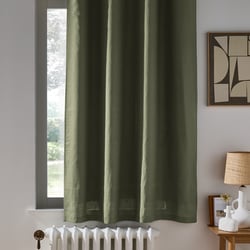
Thermal curtains are designed to help limit heat transfer at the window, although their performance depends on their construction and how they hang. Check whether the thermal feature comes from a separate lining, a coating or another specified layer. Keep curtains clear of heaters and follow the heater manufacturer's clearance guidance. If a radiator sits beneath your window, consider a shorter drop rather than letting fabric cover it.
Make green curtains work room by room
Living room: soften light without losing the view
For a living room used throughout the day, start with the position of the sofa and screen. If afternoon glare falls across your seating, choose a light-filtering green fabric you can close while keeping some daylight. If you mainly close the curtains after dark, lined panels may be more useful for evening privacy. Match muted olive with warm wood, or try a cooler green beside charcoal upholstery after checking it in the room's daylight.
Bedroom: separate daytime privacy from night-time darkness
A bedroom facing neighbouring windows may need two different levels of coverage. A light-filtering layer can provide daytime screening, while an opaque outer curtain handles evening privacy. If sleep is your priority, choose blackout performance first and then narrow down the green shades available. Position the curtain so that it does not catch on bedside furniture when opened, and check whether the gathered fabric will obstruct a window handle.
Kitchen: allow for splashes, ventilation and regular cleaning
Green curtains frame kitchen windows and complement leafy indoor plants, particularly when a soft sage sits beside white units or an olive shade echoes darker leaves. Keep fabric away from cooking flames, hot surfaces and areas where grease collects. At a window above the sink, a shorter curtain may be more practical than a long panel that brushes a wet worktop.
Check the care label before choosing kitchen curtains. A washable fabric can be useful where everyday splashes are likely, but the permitted wash temperature and drying method vary. Make sure the curtain can move clear of the opening window so you can ventilate the room without trapping fabric.
Measure the window for a comfortable fit
Start with the pole or track width
Measure the usable pole or track width, rather than the window frame alone. On a pole, exclude decorative end pieces when recording the curtain coverage. If you are fitting a new pole, allow space at each side for the curtains to gather clear of the glass, while checking for nearby walls, shelves and cupboards.
The combined curtain width usually needs to exceed the pole width to create folds. Follow the product's recommended fullness, as requirements differ between fabrics and headings. For example, a 180 cm pole with a recommended fullness of twice its width would need approximately 360 cm of curtain fabric in total. Check whether the listed width describes one panel or a pair before ordering.
Measure the drop for your chosen heading
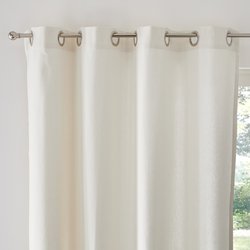
An eyelet heading hangs differently from a pencil pleat heading, so use the measuring instructions for the exact design. Eyelet curtains have fabric above the pole, whereas a pencil pleat curtain uses hooks whose position can affect the final drop. Tab tops also need their full hanging arrangement taken into account.
Measure at the left, centre and right, especially in an older home where floors may not be level. For curtains that finish just above the floor, allow a small clearance so the hem does not drag during daily use. A shorter drop can be useful above a radiator, but check the required clearance rather than letting the fabric rest on it.
- Record the pole or track width and the required finished drop.
- Check whether each pack contains one curtain or two.
- Confirm the heading is compatible with your pole or track.
- Allow room for the gathered curtains beside the glass.
- Check care instructions and any stated shrinkage allowance before altering the hem.
Check the complete choice before you buy
Ready-made curtains can simplify your selection when the available sizes suit your window. Before comparing price, check the pack quantity, fabric, lining and opacity so you are comparing equivalent options. A lower-priced single panel may not cost less overall than a pair, and an unlined curtain may need an additional layer to provide the privacy you want.
When you shop our selection, keep your measurements and room notes close to hand. Note the direction of the daylight, your preferred green shade and whether you need light filtering, blackout or thermal features. Choose the colour in the room where it will hang. Keep the window area free of clutter while you compare samples, then test your preferred shade with the lamps on. That final check helps you select curtains that work for bright mornings, quieter afternoons and evenings at home.