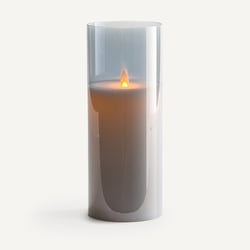
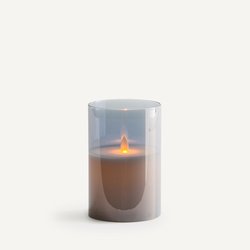
Candlelight without an open flame
Candlelight without an open flame makes evening lighting easier to manage, whether you are reading in bed, setting the table or winding down after work. LED candles give you a soft glow without a burning wick, dripping wax or smoke from an extinguished flame. You can place them on a bookshelf, arrange them along a windowsill or use them beside your bed, provided you follow the product’s placement and battery instructions.
For everyday use, the most useful differences are practical ones: how the light looks, how much space each candle needs, how long its batteries last and how you switch it on. At La Redoute, we recommend comparing glow, size, runtime and controls before deciding which style suits your room. A small tea light for a dining table has a different job from a tall pillar candle on a shelf.
Choose a glow that suits your evening routine
Warm light for background lighting
A warm LED glow works well when you want gentle background lighting rather than enough brightness to read or prepare food. Place flameless LED candles on shelves for cosy evening ambient lighting, keeping them where you can reach the switches or battery compartments. A group of three can light up a small section of shelving without the brightness of a table lamp.
Check the colour description and, where available, the colour temperature. A lower Kelvin figure generally indicates warmer-looking light, but product photographs can look different depending on screen settings. If you already use warm-white lamps in your living room, choosing similarly warm candles helps avoid an obvious contrast between yellow-toned lamps and cool-white candle lights.
Flickering or steady illumination
Flickering models vary their light output or use a moving flame-shaped element to imitate the movement of candlelight. They can work well on a mantelpiece or dining table, where the movement becomes part of the setting. A steady LED candle may be more comfortable beside a television or within your line of sight while reading, particularly if changing light distracts you.
Check whether the flickering effect can be switched off. Some models offer several modes, while others have one fixed effect. If you are sensitive to changing light, choose a steady model or one with a clearly described steady-light setting rather than relying on photographs alone.
Match the candle size to its position
Tea lights, pillars and taper candles
Start by measuring the surface or holder you intend to use. Tea lights suit small lanterns and shallow holders, but both their diameter and height need to fit. Pillar candles provide a larger illuminated feature for sideboards and shelves. A taper candle offers a slimmer shape for dining tables, although its base must fit securely into a compatible candle holder.
- For a bookshelf, check the candle’s full height, including any moving flame-shaped tip, against the available shelf clearance.
- For a dining table, choose a height and position that leave clear sightlines between people sitting opposite each other.
- For a bedside table, leave enough space for your lamp, water glass and phone without crowding the edge.
- For a window display, measure the sill depth and keep candles clear of opening handles, blinds and curtains.
- For holders, compare the internal dimensions with the candle measurements rather than judging the fit from a photograph.
A pack containing different pillar heights can help you arrange a group without stacking candles on books or improvised supports. Keep each candle on a stable, level surface. Tall, narrow designs need particular care in busy areas where a sleeve, bag or pet could knock them over.
Wax finishes and coloured designs
Some flameless candles have a real wax outer shell, while others use plastic or another material. A wax finish can resemble an unlit conventional candle in daylight, but it may soften near a radiator or in strong sunlight. Check the care instructions before placing one on a sunny windowsill. Plastic designs may be easier to wipe clean, depending on their finish and the manufacturer’s guidance.
At La Redoute, our selection includes the ÉDITÉ set of three LED one-wick candles in olive green, offering an olive-hued option for a restful evening arrangement without an open flame. You could group the set on a sideboard beside cream ceramics or position it against pale shelving so the green colour remains visible when the lights are off.
Compare battery runtime before planning your display
Battery-powered candles are convenient when there is no socket nearby, but runtime varies between models. The LED design, brightness setting, moving elements, battery type and length of daily use can all affect how often batteries need replacing. Compare stated runtime under the same conditions where possible, and check whether the figure applies to continuous lighting or a particular operating mode.
A candle described as offering 200 hours of operation would provide roughly 40 evenings at five hours per evening under the stated test conditions. Actual performance may differ, so use that calculation as a planning guide rather than a guarantee. A brighter setting or a moving flame effect may use power differently; look for model-specific information before assuming that all settings last equally long.
Check whether batteries are included and which sizes are required. A set of several candles may need more batteries than you initially expect. If each candle takes two batteries, a pack of three needs six to operate the whole display. Keep a small stock of the correct type if you use your candles nightly, and follow the instructions on suitable replacements.
For battery-operated models, do not mix old and new batteries or different types unless the manufacturer explicitly permits it. Remove depleted batteries promptly. If the candles will be stored for a long period, follow the storage instructions, which may recommend removing the batteries to reduce the risk of leakage.
Choose controls that make daily use easier
Manual switches and remote operation
A manual switch is straightforward for a candle on a bedside table or low shelf. Check its position: an underside switch means lifting the candle each time, while a side switch may be accessible without moving the display. This matters if several candles sit inside individual lanterns or among other decorative objects.
A remote control can be useful for candles on a higher shelf or spread across a room. Check its stated range and whether it needs a clear line of sight. Some remotes operate several compatible candles together, while others offer individual channels. Do not assume one remote will work with candles from another range. If independent operation matters, confirm that feature in the product details.
Keep remote controls containing coin or button batteries out of children’s reach. Check that battery compartments close securely, and stop using a product if its compartment is damaged or cannot be secured. Suspected swallowing or insertion of a battery requires immediate medical attention.
Timer settings for a regular evening glow
A timer can remove one small task from your evening routine. Many candles run for a fixed number of hours after activation, then repeat the cycle every 24 hours. For example, a six-hour timer started at 6 pm may switch the candle off around midnight and restart it at 6 pm the following day. Always check the instructions, as timer behaviour differs between models.
You can set timer-equipped LED candles in windows to glow automatically after dusk by starting the daily cycle at a suitable evening hour. A timer is not necessarily a dusk sensor. A fixed daily schedule will not automatically follow seasonal changes in sunset time, so you may need to reset it as evenings become lighter or darker.
If you want hands-free operation, check whether the timer is built into each candle or selected through the remote. Also confirm what happens after battery replacement: some models may need their schedule setting again.
Use flameless candles thoughtfully around the home
You can use battery-powered LED candles in bedrooms without an open flame burning beside bedding or books. They provide background light while you settle down, but they should not replace a reading lamp or a suitable night light for navigating the room. Keep the route between your bed and the door adequately lit if you need to move around during the night.
Flameless does not mean free from every household risk. Candles can still be knocked over, small components may present hazards, and batteries require careful handling. Keep products and spare batteries away from young children, and follow any age restrictions. Do not place candles where pets are likely to chew them or pull them down.
For indoor candle use, choose dry, stable locations unless the product is specifically rated for damp conditions. An indoor model is not automatically suitable for a bathroom, an open window exposed to rain or an outdoor table. Keep candles away from direct heat and never use them as supports for other objects.
Build an everyday arrangement you can maintain
Start with one location and a clear purpose: two small lights for the dining table, three pillars on a shelf or a single candle beside your bed. Check the effect after dark before adding more. If the glow reflects strongly in a television screen or window, move the candles slightly to the side rather than increasing the room’s lighting to compensate.
For regular upkeep, switch the candles off before cleaning and use the method recommended for their finish. Check battery compartments when replacing batteries, keep remote controls in an accessible but child-safe place, and review timer settings after seasonal clock changes. With the right size, a comfortable glow and controls that suit your routine, LED candles can provide dependable evening lighting without a daily round of lighting and extinguishing wicks.