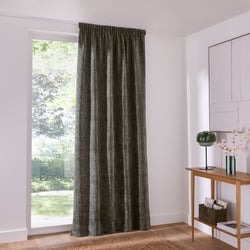
Rich texture with useful light control
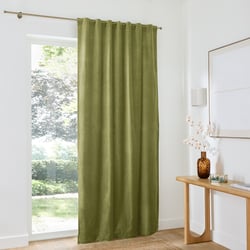
Green velvet curtains bring a soft, substantial surface to a window, but their usefulness goes beyond appearance. Draw them across a bedroom window to soften early daylight, or close them beside a street-facing sofa when you want more privacy. The way velvet catches the light also gives green shades depth: folds may look lighter along their edges and darker where the fabric gathers.
Choosing the right curtains means looking at three things in order: how the velvet feels and looks in your room, how much light the finished curtain lets through, and how its measurements work around your window. At La Redoute, we recommend checking the fabric, lining and dimensions together, so you can choose for your daily routine rather than colour alone.
Start with the feel and shade of green velvet
Let the velvet surface guide your choice
Velvet has a short pile that changes appearance as light moves across it. Beside a window, this can make the same green curtain look brighter in the morning and deeper under a lamp in the evening. Before settling on a shade, compare any available fabric sample with your wall colour, flooring and largest piece of furniture. Hold it vertically rather than leaving it flat on a table, because this more closely reflects how the curtains will hang.
Check the colour in daylight and under your usual evening lighting. A muted green that looks gentle beside a pale wall at lunchtime may appear much darker after sunset. If your living room gets little direct sun, compare a medium green with a deep forest shade before choosing the darker option for a wide window.
Choose a green that works with the room
Forest green velvet can give a pale living room a clearly defined window area, especially when the curtains sit beside cream walls or a light grey sofa. Softer green shades can suit a bedroom where you want less contrast between the walls, bedding and window fabric. Rather than matching every accessory, repeat the curtain colour once or twice in a cushion, patterned rug or bedside lampshade.
If you are comparing colours across adjoining rooms, yellow velvet curtains offer a warmer alternative for a dining space, while navy blue velvet curtains provide a darker blue option for a study. View these shades against the same wall and floor samples: changing the surroundings makes a colour comparison less useful.
Match curtain light control to your daily routine
Separate velvet thickness from blackout performance
Green velvet curtains soften morning light in the bedroom, making them useful when direct sunshine falls across the bed or dressing table. However, velvet describes the fabric surface, not a guaranteed level of darkness. An unlined curtain may filter daylight without blocking it, while a lined version can provide greater coverage. The final result depends on the fabric construction, lining and fit.
Choose a curtain described as blackout when reducing incoming light is a priority. This matters for light sleepers, shift workers and bedrooms facing bright outdoor lighting. Even blackout fabric can leave light visible around the top, sides and centre, so the curtain needs enough width and suitable positioning as well as the right material.
If colour is still undecided for a second bedroom, compare green options with other shades using the same practical criteria: stated light control, available dimensions and heading type. Matching curtain ties can also help you hold the fabric neatly when the curtains are open. A darker colour alone is not proof that a curtain will block more light.
Build privacy without losing every bit of daylight
Thick green velvet curtains add privacy beside street-facing windows, particularly when the pavement sits close to your living room or bedroom. For daytime use, though, keeping heavy curtains closed can mean switching on lamps earlier. A separate sheer layer gives you another setting between fully open and fully closed.
For example, linen voile curtains on a separate track can soften the view into a ground-floor sitting room during the day, with velvet drawn across after dark. Sheer fabric does not guarantee privacy when indoor lights are on and it is dark outside. Check the view from outdoors in the evening rather than assuming that daytime coverage will work at night.
- For gentle daytime filtering: check whether an unlined velvet panel gives enough coverage without making the room too dim.
- For stronger bedroom light control: look for a stated blackout lining and allow for coverage around the window.
- For flexible street-facing privacy: consider separate sheer and velvet layers, with enough space for both to move.
- For evening privacy: check that the curtains meet securely in the centre and cover the sides of the glazing.
Keep warmth and sound claims in perspective
A thermal curtain can help limit heat exchange around a window when its construction and fit support that purpose. Check the product description for the stated lining or backing rather than assuming every thick velvet curtain has thermal properties. Keep fabric clear of heaters and follow any clearance guidance supplied with your heating equipment.
Heavy curtains may also soften some reflected sound inside a room, such as the sharpness of conversation against bare floors and walls. They should not be treated as soundproof window coverings. If passing traffic disturbs your sleep, curtains alone are unlikely to solve the problem; check window seals and other sources of sound entry too.
Measure for coverage, folds and easy movement
Measure the pole or track, not just the glass
Once you know the light control you need, measure the full usable width of your pole or track. Measuring only the window glass can leave you with curtains that sit flat when closed or fail to cover the edges. If you are installing a new fitting, allow space beside the window for the fabric to gather when open, while checking nearby walls, furniture and switches.
Follow the product’s fullness guidance when calculating curtain width. The combined fabric width usually needs to exceed the pole or track width to create folds, but the appropriate amount varies with the heading and product. Check whether the stated width refers to one panel or a pair before calculating what to order.
For example, if a listing gives a width for each panel, two panels provide twice that flat fabric width. That total still needs to accommodate the folds; it is not automatically the width of window the pair will cover attractively.
Match the heading to your fitting
An eyelet heading slides directly onto a compatible pole and forms broad folds. Check the eyelet diameter against the pole, including any joins that could interrupt movement. Measure the drop according to the product instructions, remembering that some fabric sits above the eyelets.
A pencil pleat heading uses gathering tape and hooks, with the finished appearance depending on how evenly you gather the fabric. It can work with suitable tracks or poles fitted with rings, but the required accessories vary. Before ordering ready-made curtains, check whether hooks, rings and other fittings are included or need to be bought separately.
Measure the drop from the correct hanging point for your chosen heading. Using the same starting point for eyelet and hooked curtains can produce different finished lengths. Keep a note of the heading alongside each room’s measurements so you do not mix them up when comparing sizes.
Adjust the sizing to each room
Bedroom windows: control gaps around the edges
In a bedroom, prioritise coverage where early light enters. A curtain that barely reaches the sill may leave a bright strip below it, while a narrow pair can pull apart at the centre. Check the window from the bed as well as from directly in front of it: the angle can reveal side gaps you would otherwise miss.
Floor-length curtains can provide generous coverage where the layout allows, but they should not trail into a walking route. In a compact bedroom with a chest of drawers beneath the window, a shorter drop may be more practical. Choose the best length for the furniture and heating arrangement, then check whether an additional blind is needed for light control.
Living room bay windows: allow for bends and gathered fabric
Deep green velvet curtains frame the living room bay window, giving the window area definition against pale walls. A bay needs careful measuring because angles, brackets and nearby furniture affect how the curtains move. Measure along the intended track route rather than taking a straight measurement across the front of the bay.
Check where the open curtains will gather before choosing the width. Thick velvet takes up space when drawn back. If a sofa arm or side table sits close to the window, make sure the fabric has room to hang without being trapped. Confirm that your chosen pole or track system allows the curtains to travel around any bends as intended.
Make the final checks before delivery
Before ordering, bring your notes together: room name, fitting width, required drop, heading, lining and quantity. Check the care label too, since cleaning instructions vary between velvet fabrics and curtain constructions. Plan how you will reach the fittings safely when hanging and removing the curtains.
Once hung, arrange the folds evenly and check that the fabric has free movement across the window. Look for gaps after dark and test the morning light from your usual position in the room. With the right lining, width and drop, green velvet gives you a tactile window covering that supports how you sleep, relax and use the space each day.