Fit a square dining table for 4 around your room and routine
Before you choose a finish or order a matching set, check two things: whether four people can sit comfortably, and whether everyone can pull out their chair without blocking the room. A square dining table for 4 gives each person their own side, but the tabletop is only part of the footprint. Chairs, table legs, nearby cupboards and the route through your kitchen all affect how well it fits.
Start with the space you use every day. Four family members sharing weeknight dinners need room for plates, glasses and serving dishes, while someone carrying food from the kitchen needs a clear route to the table. At La Redoute, we suggest working from measurements first, then checking seating, materials and upkeep against your household routine.
Start with the square tabletop footprint
Choose dimensions that suit your place settings
A square table measuring around 80 × 80 cm can seat four for straightforward meals, although shared dishes may need to stay on a nearby counter. Around 90 × 90 cm usually gives each diner more elbow room and leaves a little more space in the centre. A 100 × 100 cm tabletop can accommodate larger place settings, but it also needs a wider area around it. These are planning guides rather than guarantees: leg position, chair width and the shape of the table edge all influence usable seating space.
Mark the tabletop outline on the floor with masking tape before buying. Then place four chairs around that outline, or mark their positions if you have not chosen them yet. This makes it easier to judge whether a small square table genuinely fits beside your kitchen units, rather than simply looking compact in a product photograph.
Test the surface area too. Lay out four dinner plates, glasses and cutlery within the proposed dimensions on an existing surface. Add the items you regularly share, such as a salad bowl or a water jug. If everything crowds the edges, consider a larger square or plan to serve food from a sideboard.
Allow for chair movement and passing space
The floor area you need is larger than the tabletop on its own. As an initial guide, allow around 75 cm between the table edge and a wall or other obstruction for chair access. This may feel tight with bulky chairs or for anyone who needs more room to move. Where people regularly walk behind seated diners, aim for around 90-120 cm and test the route with your actual furniture.
- Measure from the table edge, not from the centre of the room.
- Check that cupboard doors, drawers and the dishwasher can open during meals.
- Leave the main route between the kitchen and living area clear when all four seats are occupied.
- Allow extra space for a highchair, mobility aid or a chair that cannot tuck fully underneath.
- Check nearby radiators and curtains, which can reduce the usable gap beside a chair.
For example, a 90 cm square tabletop with 75 cm of clearance on every side needs an area of roughly 240 × 240 cm. That calculation is a useful starting point, not a substitute for checking your layout. A doorway or breakfast bar may mean you need more clearance on one side than another.
If you regularly host more than four people, compare that everyday footprint with an extendable dining table that seats 8 option. Check both its closed and extended measurements: occasional extra places are only useful if guests can still move around the extended table.
Check four-person seating before choosing chairs
Match chair width to the space between the legs
A four-seat description tells you the intended capacity, but not whether every chair style will fit. Check the clear distance between the table legs against the width of your chosen chair. A wide upholstered seat may sit comfortably at the tabletop yet refuse to slide underneath because its frame catches the legs. Arms can create the same problem if they meet the underside of the table or its apron.
Many dining tables are around 74-76 cm high, while dining chair seats often sit around 45-48 cm from the floor. Check the exact product measurements and the clearance beneath the apron, rather than relying on these typical figures. You need enough space for thighs and comfortable movement, especially with padded seats that sit higher than expected.
When browsing dining sets, examine the measurements of each piece rather than assuming that matching finishes guarantee a comfortable fit. If you shop for the table and chairs separately, note the overall chair width, seat height, arm height and depth. Compact armless chairs can help with space saving because they often tuck further beneath the tabletop, but their backs may still project into a walkway.
Plan for meals, brunch and board games
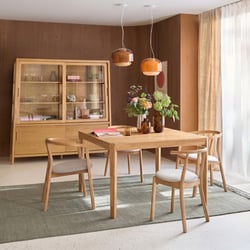
A square layout gives each diner a separate side, so nobody needs to sit at the end of a long table. For two couples enjoying brunch, that arrangement keeps conversation within easy reach and gives each person a defined place for a plate and cup. Put shared dishes in the centre only if everyone can reach them without leaning across another setting.
Friends playing board games also benefit from equal sides, but check the board dimensions before choosing a particularly small tabletop. A large board, four player areas and drinks can quickly fill an 80 cm square surface. A nearby shelf for snacks keeps the playing area clear without forcing glasses close to the edge.
If your usual seating needs vary, compare a square layout with a round extendable dining table. The rounded edge changes how you move around the furniture, while the extension changes its footprint. Neither shape removes the need to measure chair clearance in its largest configuration.
Choose materials around daily use
Consider wood, veneers and visible grain
A wooden dining table brings visible grain into a kitchen or open-plan room, but its practical qualities depend on the construction and finish. Solid wood, wood veneer and coated board require different care, so read the material details before deciding. Veneer provides a layer of real wood over a supporting material; it should not be treated as though it can withstand deep sanding.
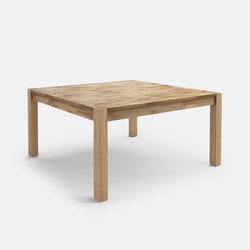
At La Redoute, our Hale Square Smoked Oak Dining Table (Seats 4) by ÉDITÉ combines oak veneers and rubberwood with a smoked finish, bringing retro style and a contemporary feel to a four-person dining layout. Its darker wood tone is worth considering alongside your floor and chairs: request a sample if available, or view the product images in several room settings to assess the contrast.
Choose a finish with your actual meals in mind. If children regularly spill breakfast milk or leave damp cups on the table, check the manufacturer's cleaning instructions and use suitable mats. Do not assume that a dark finish hides every mark; crumbs, water rings and scratches can remain visible depending on the surface.
Compare glass, metal and painted finishes
A glass dining room table lets you see more of the floor beneath it, which can make its footprint less visually dominant in a narrow room. It does not reduce the clearance needed for chairs, and fingerprints may be noticeable after meals. Check the glass specification, edge design and care guidance, particularly in a household with young children.
Metal legs can suit a modern dining area and may leave a different amount of knee room from chunky wooden legs. Their position matters more than their slim appearance: an angled support can still sit where you want to place your feet. Check for suitable floor protectors, especially on hard flooring where moving chairs can cause scratches.
For a lighter colour scheme, you might compare a square model with a white extendable dining table, particularly if extra seating matters as much as the finish. If you prefer darker furniture, a black round table offers a useful comparison for colour and shape. Keep returning to your measured plan so that an appealing finish does not distract from chair fit.
Keep upkeep straightforward from the first meal
Build a care routine around the surface
Follow the care instructions for the specific tabletop finish rather than using the same cleaner on every material. For many surfaces, a soft cloth and prompt attention to spills are a sensible starting point, followed by drying where advised. Avoid soaking joints and edges, and test any recommended cleaning product in an inconspicuous area first.
- Use heat-resistant mats beneath hot serving dishes, following the table's care guidance.
- Wipe up spills promptly instead of leaving them until the end of dinner.
- Lift plates, bowls and decorative objects rather than dragging them across the surface.
- Check fixings periodically if the assembly instructions recommend it.
- Replace worn floor pads before chair movement starts marking the floor.
Keep regularly used mats and coasters in a nearby drawer so you can set the table quickly on busy evenings. If your dining area also handles homework or puzzles, use a suitable protective covering for pens, glue and other materials that could stain or scratch the surface.
Check delivery and assembly before ordering
Once the measurements, seating and material suit your routine, check the delivery information and package dimensions. A tabletop that fits your dining area may still be difficult to carry through a narrow hallway or up a tight staircase. Confirm whether assembly is required, what tools are needed and whether the tabletop and base arrive separately.
Before checkout, take one final view of your taped floor plan with all four chair positions occupied. Open the nearest cupboard, walk past with a tray and sit down at each side. A comfortable fit means the whole dining arrangement works during use, not just when the chairs are tucked away. That practical check helps you choose a square table for four that supports everyday dinners without taking over the room.